About the project
The problem
Analyzing a match means cross-checking recent form, statistics and context from separate sources. Inphera brings those signals into a single experience so users can review them with traceability, without presenting the analysis as a certainty.
Current user flow
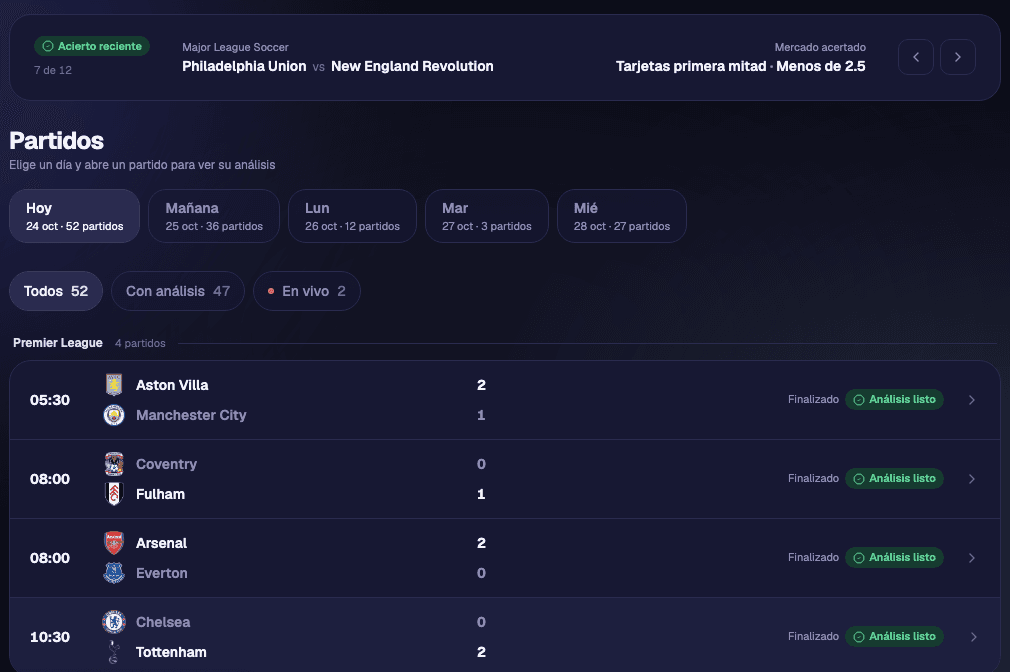
- 1Pick an available match.
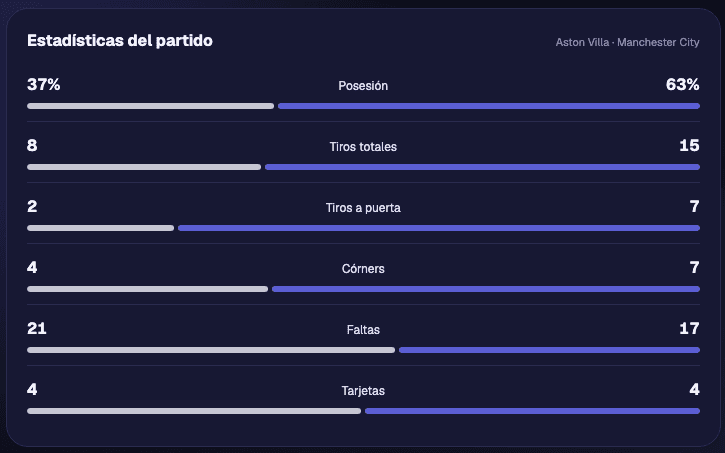
- 2Review the direct averages of recent games and the context for both teams.
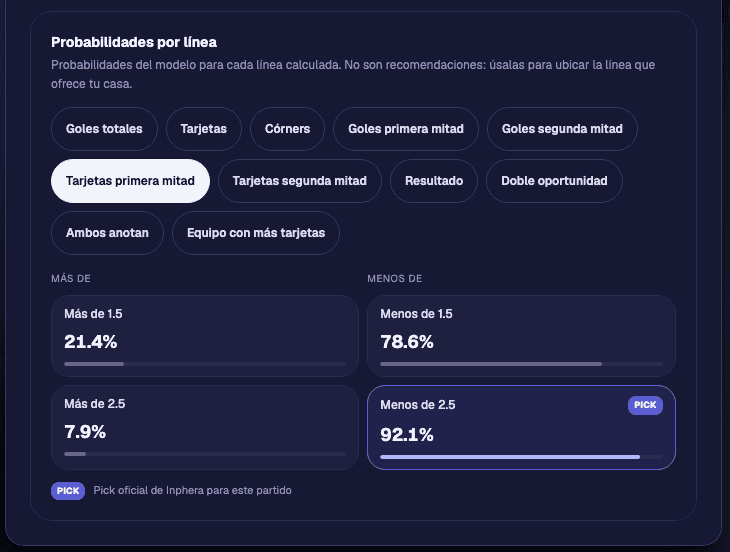
- 3Check the probabilities per market and see which ones passed the recommendation filter.
- 4Read a contextual summary and keep the final judgment on how to interpret the data.
Current methodology
- Recent-match averages are a direct aggregation of the available history.
- Poisson is the mathematical probability model used to estimate the different markets.
- Self-calibration adjusts weights with a heuristic based on observed results; it is not a trained machine learning model.
Structured analysis with Claude
- Claude receives statistics, context and precomputed mathematical signals to produce a structured analysis.
- Within that structure it outputs candidate markets, candidate probabilities and reasons. These outputs are conditioned on the context provided, but they are not yet visible recommendations.
Deterministic guardrails
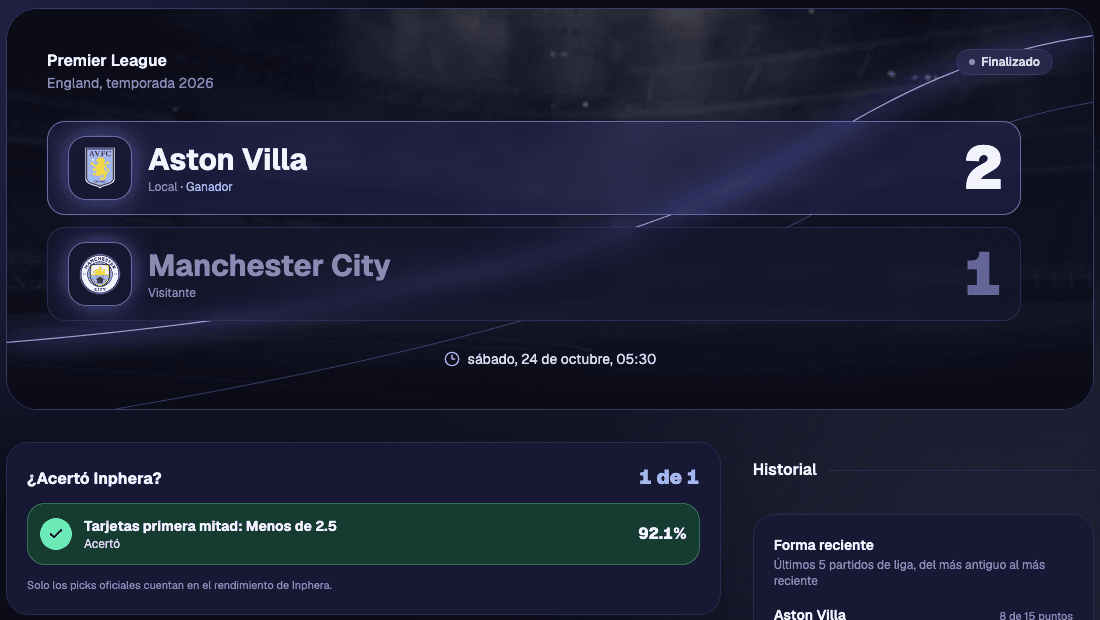
- After the structured analysis, filterRecommendedBets applies a post-filter and only lets candidates with a probability of 65% or higher through to the recommendations UI.
- Claude cannot bypass that deterministic comparison. The threshold controls what is shown, but it doesn't guarantee wins or remove the uncertainty of sport.
Roles and stack
- Claude synthesizes the context it receives and generates structured candidates; the application code decides which ones are finally shown as recommended.
- The experience connects a Next.js interface with a FastAPI math engine, data stored in Supabase and Claude's structured output.
Current status: private beta
Inphera is in development and is being tested with limited access. Its results are informational and experimental: they are not financial advice or a promise of outcomes.
ML roadmap
Supervised learning is future work. It will only be evaluated once there is enough labeled historical data to train, validate and compare models responsibly.